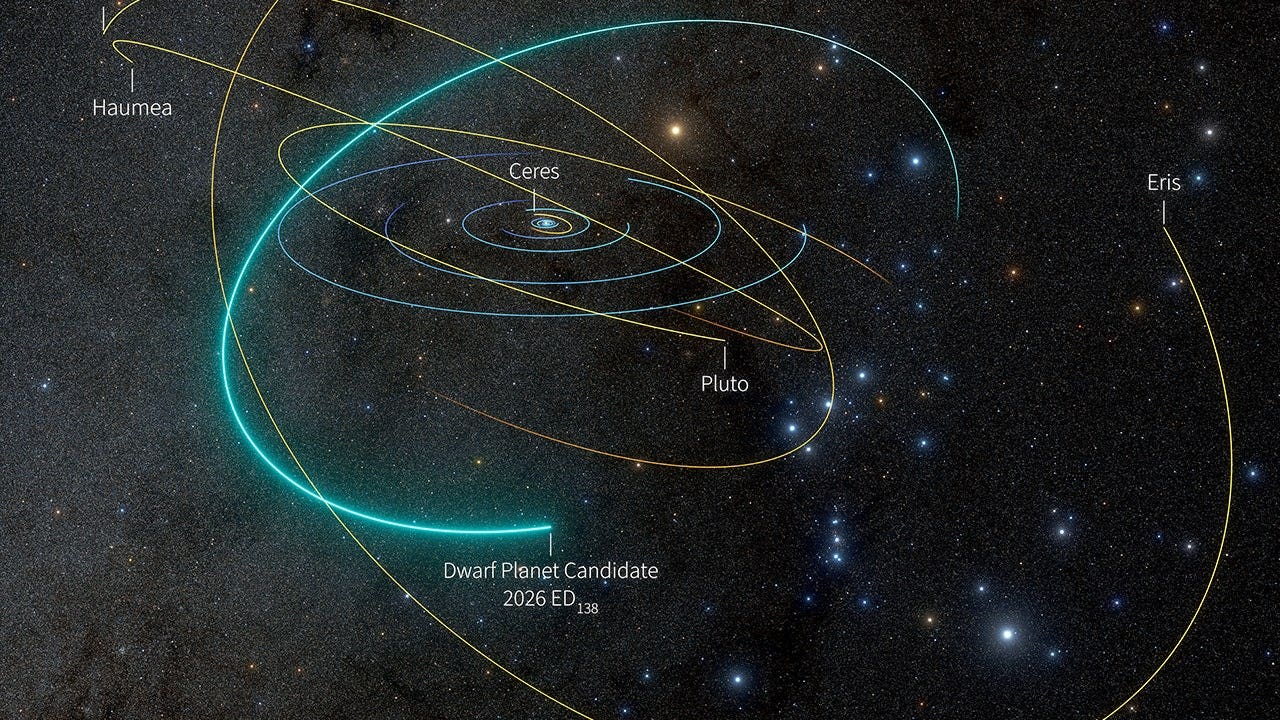
A powerful new telescope has made a groundbreaking discovery by identifying a candidate for a dwarf planet beyond Pluto. This intriguing celestial body, designated as a potential member of the Kuiper Belt—a region filled with icy remnants from the early solar system—has sparked significant interest among astronomers and planetary scientists. The discovery not only expands our understanding of the solar system's outer reaches but also raises questions about its formation and the characteristics of other similar objects that might exist in this distant region. The candidate is believed to be one of the largest dwarf planets ever identified, which could challenge our current definitions and classifications within planetary science.
The telescope, equipped with cutting-edge technology and advanced imaging capabilities, was able to detect this distant object by capturing its light reflected from the Sun. This method of observation is crucial in the cold, dark regions of the solar system where sunlight is faint. The discovery is part of a broader initiative aimed at mapping the Kuiper Belt, which is thought to harbor thousands of small celestial bodies, many of which remain undiscovered. The existence of such a large candidate raises questions about the dynamics of the Kuiper Belt and the potential for more large objects lurking in the shadows of our solar system, waiting to be observed.
Scientists are now analyzing data collected from the telescope to ascertain the size, composition, and orbit of this dwarf planet candidate. Initial estimates suggest it could rival or even surpass known dwarf planets, such as Eris and Haumea, in size. Understanding the properties of this newfound object is essential not only for classifying it correctly but also for gaining insights into the processes that govern the formation of celestial bodies in the outer solar system. As researchers continue to study the data, they hope to learn more about its surface characteristics and atmosphere, if it has one, which will provide clues about its history and the conditions it has endured since the formation of the solar system.
This discovery underscores the importance of ongoing astronomical research and the need for advanced telescopes to explore the unexplored corners of our solar system. As technology continues to advance, scientists anticipate that more such discoveries will be made, enhancing our understanding of celestial mechanics and the evolution of planetary bodies. The potential existence of other large dwarf planets beyond Pluto may lead to a reevaluation of how we define planets and dwarf planets, prompting discussions within the scientific community about the criteria used for classification. Overall, this discovery not only excites astronomers but also ignites the curiosity of the public, reminding us of how much there still is to learn about our cosmic neighborhood.
Scientists discover potentially massive dwarf planet candidate hiding beyond Pluto - Fox News