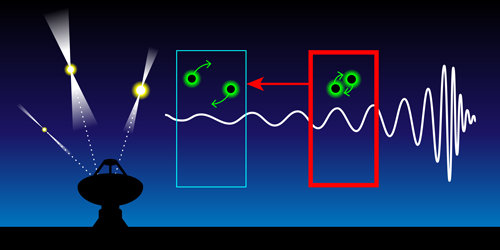
Galactic history stretches back billions of years, encompassing an intricate tapestry of events that have shaped the cosmos as we know it today. From the formation of the first stars and galaxies to the more recent collisions and mergers of these vast structures, the universe has undergone significant transformations. The study of galactic evolution not only helps astronomers understand the lifecycle of galaxies but also sheds light on the fundamental forces and processes that govern the nature of the universe. Key to this narrative are supermassive black holes, which reside at the centers of most galaxies, including our own Milky Way. These enigmatic objects, with masses millions to billions of times that of the Sun, play a crucial role in the dynamics of galactic mergers and influence the subsequent evolution of the galaxies involved.
When galaxies collide, the gravitational interactions can lead to the merging of their central supermassive black holes, creating a binary system of these colossal entities. As these black holes orbit each other, they emit gravitational waves—ripples in spacetime predicted by Einstein’s general theory of relativity. The detection of these waves is not just a theoretical exercise; it represents a new frontier in astrophysics. Observatories like LIGO (Laser Interferometer Gravitational-Wave Observatory) and Virgo have already made groundbreaking discoveries, providing a new way to observe cosmic events that are otherwise invisible. The merger of supermassive black holes is expected to produce gravitational waves in a frequency range that could be detectable by future observatories, further enriching our understanding of the universe's history.
The emission of gravitational waves during these mergers has profound implications for our understanding of galaxy formation and evolution. As these waves propagate through the universe, they carry information about the masses, spins, and orbital dynamics of the merging black holes. Analyzing this data can provide insights into the conditions present during the early universe and the mechanisms that lead to the formation of galaxies. Furthermore, the study of gravitational waves offers a complementary approach to traditional electromagnetic observations, allowing researchers to investigate phenomena that are difficult to study with light alone, such as the behavior of black holes in dense galactic environments or the interactions between them during the final stages of a merger.
As we continue to advance our observational technologies and theoretical models, the field of gravitational wave astronomy is poised to revolutionize our understanding of galactic history. The potential to detect and analyze the gravitational waves produced by supermassive black hole mergers will not only deepen our knowledge of these fascinating objects but will also enhance our comprehension of cosmic evolution on a grand scale. Future missions and observatories, such as the proposed LISA (Laser Interferometer Space Antenna), aim to further explore this domain, opening new pathways to uncover the mysteries of the universe. In essence, the convergence of gravitational wave astronomy with traditional astrophysical methods could illuminate the complex processes that have shaped galaxies, offering a richer narrative of our cosmic heritage.
Using Pulsars to Probe Early Growth of Black Holes - American Physical Society