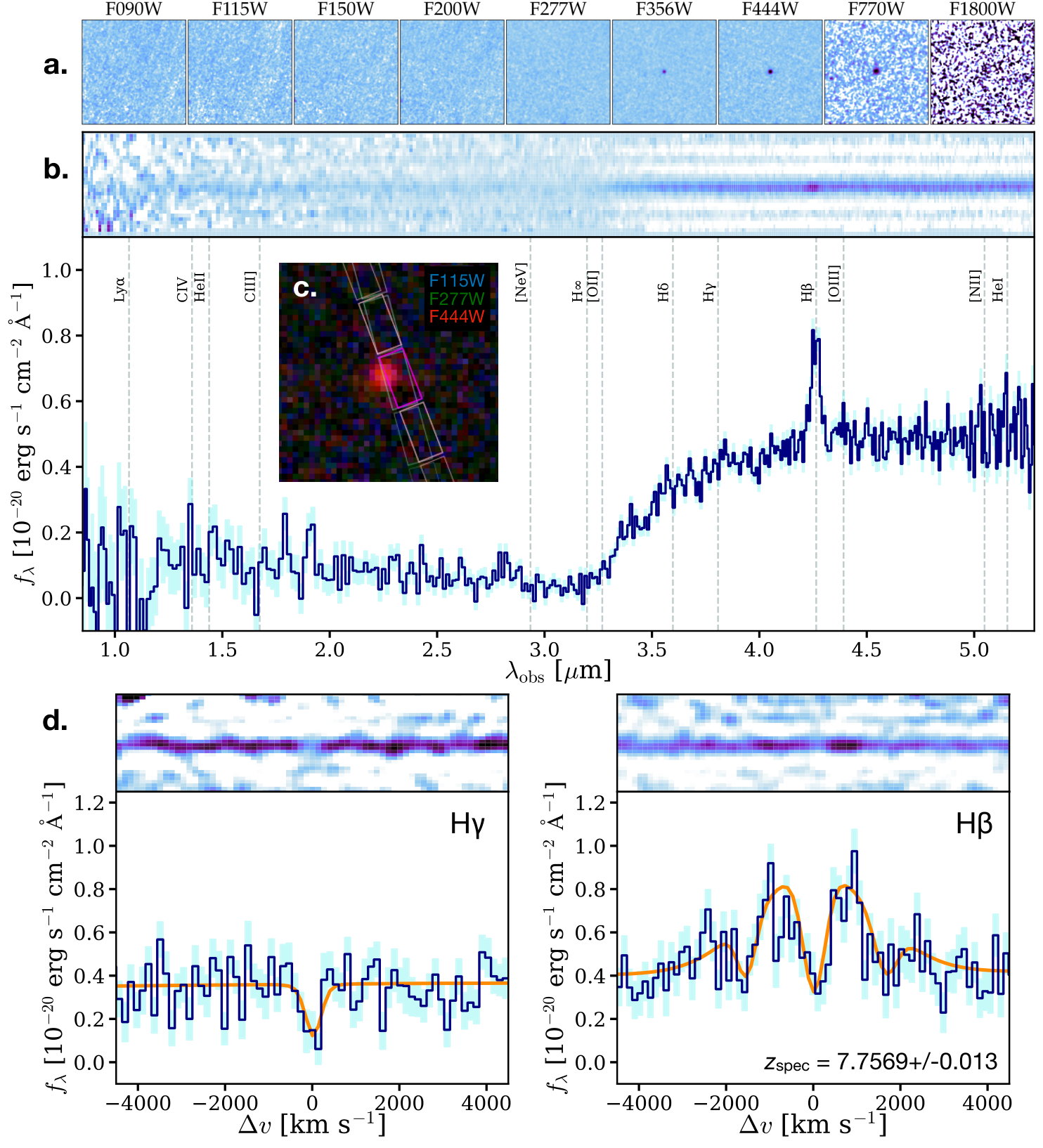
In the vast expanse of the universe, the James Webb Space Telescope (JWST) has unveiled remarkable discoveries, one of which is the intriguing object designated as MoM-BH*-1. This celestial body, captured in a striking image by Webb, appears as little more than a mere red point against the backdrop of the cosmos. At first glance, one might easily overlook it, mistaking it for a faint star or distant galaxy. However, the true significance of MoM-BH*-1 becomes apparent when scientists delve deeper into its spectrum. Unlike typical celestial objects, its spectral signature reveals a complex and unusual composition, prompting astronomers to reconsider the nature of early cosmic structures and their formation in the universe.
MoM-BH*-1 is remarkable not only for its unique spectrum but also for its incredible age. This object is believed to have existed around 660 million years after the Big Bang, a time when the universe was in its infancy. During this epoch, the cosmos was undergoing rapid changes, transitioning from a hot, dense state into a cooler, more structured environment. The study of MoM-BH*-1 provides invaluable insights into the conditions that prevailed during this critical period of cosmic evolution. By analyzing its characteristics, researchers can glean information about the formation of the first stars and galaxies, shedding light on how these early structures contributed to the subsequent development of the universe.
The extraordinary nature of MoM-BH*-1 raises essential questions about the processes that led to the formation of supermassive black holes and their host galaxies. The object’s spectrum suggests interactions and phenomena that are not commonly observed in typical stars or galaxies. These findings challenge existing theories and encourage astronomers to explore new models that account for the rapid growth of black holes in the early universe. As the JWST continues to observe and analyze distant objects like MoM-BH*-1, it opens up new avenues of research, allowing scientists to piece together the cosmic puzzle of how matter coalesced into the complex structures we observe today.
The discovery of MoM-BH*-1 exemplifies the transformative power of advanced observational technology in astronomy. The capabilities of the James Webb Space Telescope enable astronomers to detect and analyze distant objects with unprecedented detail, revealing phenomena that were previously hidden from view. As more data is collected and analyzed, the implications of MoM-BH*-1 and similar objects will undoubtedly reshape our understanding of the early universe. This revelation not only deepens our knowledge of cosmic history but also underscores the importance of ongoing exploration and inquiry in the field of astrophysics, as we strive to comprehend the origins and evolution of our universe.
James Webb spotted a bizarre object just 660 million years after the Big Bang that looks like an enormous star but shines with roughly 100 billion Suns' worth of energy — because hidden inside its star-like cocoon is an accreting black hole, rather than a core - Space Daily